UX Study · Academic · Mixed Methods
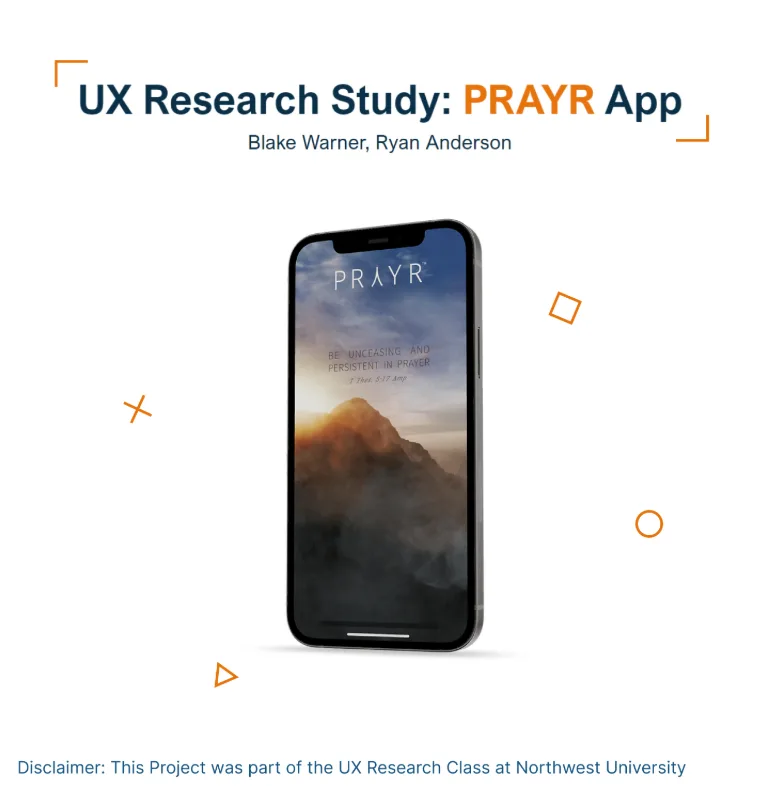
Prayr App UX Research
Northwest University · 2023 · UX Researcher · w/ Ryan Anderson
Overview
Prayr is a faith-based mobile app for iOS designed to support personal and communal prayer practice. It provides daily prayer prompts, scripture, and tools for tracking prayer intentions — positioned in a competitive space alongside apps like Lectio 365 and Hallow.
This project was a full mixed-methods UX research study conducted as part of the UX Research class at Northwest University. The goal was to evaluate Prayr's usability and discoverability, identify friction points in the core user flows, and produce concrete design recommendations backed by both qualitative and quantitative data.
Design Challenge
How might we improve the discoverability and usability of Prayr's core features so users can engage more deeply with their prayer practice?
User interviews and task testing revealed that while the app's purpose resonated strongly with its audience, several key features were difficult to find, and the onboarding did little to orient new users to the app's full capability.
Methodology
User Interviews
Semi-structured interviews with target users to understand prayer habits, app expectations, and initial reactions to Prayr's feature set.
Moderated Task Testing
Participants completed scenario-based tasks covering core flows: setting up a prayer, finding community features, and navigating daily content.
Affinity Mapping
Qualitative data from interviews and sessions was synthesized via affinity mapping to surface recurring themes and patterns.
Performance Metrics
Task completion rate and time-on-task tracked across all moderated sessions to provide quantitative baselines for each recommendation.
Task Objectives
- Evaluate discoverability of Prayr's core prayer-setting and tracking features
- Measure task completion rate across primary user flows
- Identify navigation and labeling issues that prevent feature access
- Surface emotional friction points — moments where the app's tone or flow broke the meditative experience
- Compare user mental models of "prayer app" against Prayr's actual feature structure
Key Findings
Finding 01
Core features are buried — discoverability is the top issue
Most participants failed to locate key features (prayer journal, community prayers) on the first attempt. Navigation labels used faith-specific terminology that didn't match users' mental models of how a prayer app should be organized.
Finding 02
Onboarding doesn't orient users to the feature set
New users received no structured introduction to the app's capabilities. Most didn't discover the community prayer feature at all during sessions — not because it didn't resonate, but because they never found it.
Finding 03
Visual hierarchy makes daily content feel like the only feature
The home screen emphasized daily devotional content so heavily that other features appeared secondary or optional. Users interpreted this as Prayr being only a devotional app, not a full prayer toolkit.
Finding 04
The tone and visual design are strong — users connect emotionally
Every participant responded positively to the app's aesthetic — the nature imagery, calm color palette, and scripture integration felt appropriate and trustworthy. The emotional design is a genuine asset.
Recommendations
1
Redesign navigation labels to match user language
Replace faith-specific tab names with plain-language equivalents. Users navigated by guessing — language should remove that friction.
2
Add a feature-aware onboarding flow
Introduce 3–4 key features during first launch with contextual tips. Focus on prayer journal and community — the features users missed most.
3
Restructure home screen hierarchy
Surface secondary features (journal, community) via home screen cards or quick-access buttons alongside daily content — not just in navigation tabs.
4
Add visual indicators for community activity
Notification badges and activity counts would signal that community features are active and used — reducing the perception that the app is purely personal.
5
Simplify the prayer creation flow
Reduce the number of steps to add a new prayer intention. Current flow requires 4+ taps to log a prayer — should be achievable in 2.
6
Leverage the strong visual identity more broadly
The emotional design is the app's biggest strength. Apply the same care to secondary screens and empty states — moments where the experience currently drops in quality.
Outcome
6Design recommendations
4Key findings documented
MixedQual + quant methods
NUNorthwest University project
What I Learned
- Affinity mapping is where the real insight happens — individual data points look scattered, but patterns become obvious when you spatially cluster them with a collaborator.
- Users will tolerate bad navigation if the emotional experience is strong enough — but only up to a point. Prayr's visual design bought it a lot of goodwill that usability issues would otherwise have eroded.
- Faith-based apps have a unique challenge: the tone of the product needs to feel consistent with the activity it supports. A jarring UI moment in a prayer app feels more disruptive than the same moment in a productivity tool.
Previous
Mercari Usability
Next
VR Skill Labs